
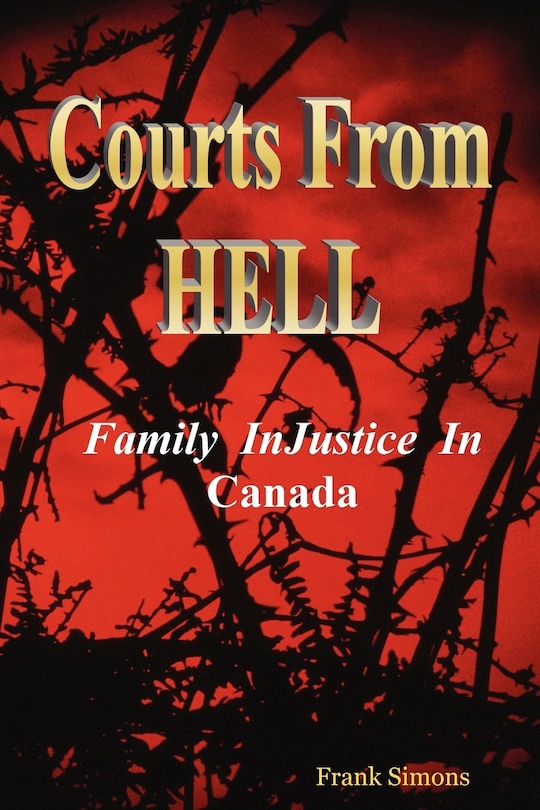
Courts From Hell - Family Injustice In Canada. The book details the destruction done to families by the dysfunctional Canadian Justice System.Courts From Hell - Family Injustice In Canada. The book details the destruction done to families by the dysfunctional Canadian Justice System. In Canada. The book details the destruction done to by he dysfu
 Canadian Public Education: The Road to Crime
Let us ask the current regimes in Canada: To whom do children belong from the moment they begin their schooling in public institutions: to their parents or to the government? When our children are deprived of an education and respect that is neither taught nor instilled in them, and public schools prepare them to commit crimes with the help of thuggish police officers, the burgeoning social services industry, and hellish courts, why do the regimes in power blame the parents?
 Let
us also denounce how corrupt Canadian criminal and family courts
operate against people of colour, especially when those who file false
complaints are white. It is often observed that judges and prosecutors,
from their high positions, spew racial hatred and sadism, humiliating
their victims without any evidence of alleged mental illness. These are
terrible injustices and transgressions of the law, and most of the
accused do and say nothing. Is it easy to remain silent? But not for
those who have the courage to denounce these psychopathic judges,
prosecutors, and public defenders who control the justice system and
reserve it only for a privileged few.
Let
us also denounce how corrupt Canadian criminal and family courts
operate against people of colour, especially when those who file false
complaints are white. It is often observed that judges and prosecutors,
from their high positions, spew racial hatred and sadism, humiliating
their victims without any evidence of alleged mental illness. These are
terrible injustices and transgressions of the law, and most of the
accused do and say nothing. Is it easy to remain silent? But not for
those who have the courage to denounce these psychopathic judges,
prosecutors, and public defenders who control the justice system and
reserve it only for a privileged few. "CANADA THE LIVING HELL THAT NOBODY DOESN’T KNOW" A MONSTROUS PRISON THAT WE CHOOSE TO LIVE!
Crimes against humanity in the Rome Statute
Canada is a country of pain and mourning, a land of aberrant crimes, of human misery; without any hope! "An ocean whose fierce waves drag millions of lacerated lives." .- Nadir Siguencia
The definition of the Spanish Legal Dictionary is, in any case, a summary or interpretation of the original concept. Since the end of the 19th century, and especially after the world wars, International Law has been classifying the criminal conduct that it considered most serious, those that attacked fundamental rights. And it included some of these in the Rome Statute of the International Criminal Court, of July 17, 1998. This is where the foundations of the concept of crimes against humanity are laid.
They are defined, specifically, in article 7. It cites, as in the previous definition, murder, extermination, slavery, deportation, torture or deprivation of physical liberty in violation of the rules of International Law. But, in addition, other crimes are added. Among them, the “persecution of a group or collectivity with its own identity based on political, racial, national, ethnic, cultural, religious, gender reasons…”. And apartheid or the forced disappearance of people are mentioned, among them.
In addition, sexual crimes are added. “Rape,
sexual slavery, forced prostitution, forced pregnancy, forced
sterilization or other sexual abuses of comparable gravity.” Like
the rest, all of them will be considered crimes against humanity as
long as they are also committed “as part of a widespread or systematic
attack against a civilian population and with knowledge of said attack.”
Widespread or systematic attack on a population, whether by a third party or by some State authority. Example: “The persecution of people for their political ideas is a crime against humanity.”
ATROCITY AFTER ATROCITY: "Canadian Hospitals Chambers of Torture”

Art. 7 of the Rome Statute: “For the purposes of this Statute, “crime against humanity” means any of the following acts when committed as part of a widespread or systematic attack directed against any civilian population and with knowledge of such attack: a) Murder; b) Extermination; c) Enslavement; d) Deportation or forcible transfer of population; e) Imprisonment or other severe deprivation of physical liberty in violation of fundamental rules of international law; f) Torture; g) Rape, sexual slavery, enforced prostitution, enforced pregnancy, enforced sterilization or any other form of sexual violence of comparable gravity; (h) Persecution of any identifiable group or collectivity on political, racial, national, ethnic, cultural, religious, gender-based grounds as defined in paragraph 3, or other grounds universally recognized as impermissible under international law, in connection with any act referred to in this paragraph or with any crime within the jurisdiction of the Court; (i) Forced disappearance of persons; (j) The crime of apartheid; (k) Other inhuman acts of a similar character intentionally causing great suffering or serious harm to physical integrity or mental or physical health.” https://www.oas.org/36ag/espanol/doc_referencia/Estatuto_Roma.pdf. G.O.E. No. 5,507 of December 13, 2000.
Crimes against humanity do not have a statute of limitations
There is no time limit for reporting or prosecuting a crime against humanity in order for the alleged perpetrators to be tried.
Furthermore, crimes against humanity can be reported and prosecuted in any country. In theory, their seriousness allows any State, without the need for the victims or perpetrators to be of its nationality, or for the crimes to occur in its territory, to accuse and condemn these crimes under its legal system. However, this is usually exceptional, given the complementary work of the ICC.

I live in fear; I’m scared and shocked, every day at all. You know my Honor’s, It’s true, the true, the only truth I’m terrified of this inexcusable police force at all They are horrifying liars and brutes against me.
Reviewing the lawless police notes indicate Nadir is... Six feet tall, two hundred and twenty pounds You know my honor; I’m not a giant with that weigh “I’m not, a cruel, a sadist, a brute, a beater and a killer”
The true is only five feet five, one hundred
sixty five
What? Flawless intentions of criminals, murderers and
assassins Over the
years the police force labeled me, as a Violent, crazy….. Don’t blame me for yours unmercifully beatings and crazy killings.
I decided it is better to scream. . . . Silence is the real crime against humanity. N. Mendelstam
 The
only way to portray my pain and my emotions so vividly, the motif of
Master Guayasamín's painting also highlights between my fingers the
desperation that I have on my face for my family.
The
only way to portray my pain and my emotions so vividly, the motif of
Master Guayasamín's painting also highlights between my fingers the
desperation that I have on my face for my family.Sunday, 15 February 2026
Canada, the living hell you don't know about, "a monstrous prison we choose to live in"

Attacker (Confusion - Doubt - Suicides)
What happened in Tumbler Ridge, British Columbia, Canada, is an unprecedented tragedy, but the truth is not what the police are telling us about Jesse Strang, the attacker. What the public wants to know is what happened in his short life, especially during his school years, and what motivated him to choose this school to commit murder.
When Your Government Wants to Remove Sex From Sex-Ed
Doug Ford's fight against Ontario’s curriculum is an assault on reality
Lauren McKeonDoug Ford’s first five weeks since winning Ontario’s provincial election carry a clear message: the undoing has begun. The new premier has restricted universal pharmacare for those under twenty-five, cut the $377 million Green Ontario Fund, cancelled school-infrastructure repairs, reversed a decision to increase police oversight, and refused to help the federal government shoulder the financial burden of housing asylum seekers in the province.
Ford sold his decision as a temporary, back-to-basics fix to give his government time to develop yet another new curriculum via a “fulsome consultation respecting parents.” In truth, he gave many of his right-wing supporters their most significant policy victory in years. Those who have criticized the 2015 curriculum often rail against its “radical” agenda, one that “has nothing to do with science, health or the wellbeing of children,” as the CLC argues in an online post, “but rather, everything to do with a political agenda by adults whose goal is sexual revolution.” These groups aren’t entirely wrong: in addition to updating the document to include a focus on navigating social media and the internet, the 2015 curriculum prioritizes consent and is built on a LGBTQ-positive framework. If that’s a radical revolution, however, it’s one that coincides with Canada’s Human Rights Act and also its Criminal Code—the former of which is often viewed by conservatives as an affront to freedom of speech.
Of course, all this pearl clutching belies the anti-sex-education advocates’ own agenda. That is, to send us all back to a past in which masculinity and femininity fit into neat boxes and follow a Leave it to Beaver–style moral code. In this world, the nuclear family rules, faith governs sexual acts, and nobody ever has premarital sex. If you believe in this world, then the former curriculum is a threat because it “detaches sex from love, commitment, responsibility, marriage, faith, moral values and social consequences”—that’s according to one of the main lobby groups, the Parents Alliance of Ontario for Better Education (PAO). Or, you might believe, as a sex-ed opponent wrote to the Toronto Star in 2015, that it would “teach Gay-Trans propaganda” and “[d]estroy the idea of gender, natural law, heterosexual family normalcy.”
Complaints against the former curriculum, are, by now, both well worn and, largely, debunked. Many of them—including that children would learn “graphic” lessons on body parts in grade one and that by grade six they’d be “encouraged” to masturbate—indicate a willful misreading of the document. Others—such as what older children and teens would learn about anal sex and gender identity—are steeped in homophobia and transphobia.
Groups that attacked the 2015 curriculum frequently relied on the argument that it is parents, not schools, who should be teaching children about sex. Often, that was just code for: we want the absolute power to protect our moral beliefs from outside challenges. One high-school principal in BC, for instance, even wondered in 2015 whether Ontario’s curriculum amounted to “cultural genocide” against Christians. Sex-ed may be one of the religious right’s most high-profile moral battles, but it’s also one front in a larger war for ideological sovereignty.
The education minister has since announced that schools will continue to teach things like consent and gender identity this fall, but addressing such topics is not the same as building an educational framework around them. Her statement also flatly contradicts the message of the very groups Ford has sided with in his fight against the 2015 curriculum. Many of those who carried the “stop sex ed” call forward, for example, are also the same people who fought Ontario’s Bill 89, which essentially brings the province’s definition of child and youth well-being in line with its Human Rights Code, as well as Canada’s Charter of Rights and Freedoms. That is, under the bill, a child’s right to their own sexual orientation, gender identity, and gender expression are protected within the home. During the provincial election, three candidates even ran under the brand new Stop the New Sex Ed Agenda Party and extended their target to the bill. Much like they did with the sex-ed curriculum, far-right conservatives positioned the bill as a totalitarian attempt by the Liberals to control them. “As a parent in Ontario today, you have no say in the classroom, but you have a say in your own home,” wrote Faith Goldy for Rebel Media, introducing a petition against the bill.
Like Donald Trump has done in US with immigration and trade, Ontario conservatives have used sex ed—and the surrounding issues of gender and LGBTQ rights—to stoke a colossal fear that a certain way of life is under attack. Viewed that way, Ford scrapping the province’s modernized sex ed is only the latest sign of the growing political clout of a once-fringe brand of social conservatism. It’s also a reminder that we may be entering an era of regressive values, one that will be marked by a push to reset everything from racial privilege to gender roles.
In so many ways, Doug Ford’s decision isn’t about sex education at all; it’s about a moral show of strength. By contesting the 2015 curriculum, Ford, and others, are asserting who is—and who is not—entitled to a healthy sexual life. Asserting that the document is dangerous because it “equalizes homosexual and heterosexual acts in the young minds,” “confuses children with six genders,” and “promotes sexual knowledge, sexual pleasure and sexual freedom,” isn’t so much a way to keep sex ed in the home or to protect children, as the PAO argues. It’s a way to undermine modern, progressive views on sex and gender. If one removes the positive references to consent and the LGBTQ community, the 2015 update is strikingly similar to much of the ’90s-era curriculum. If Ontario does indeed revert to the old approach, first graders will still learn how to properly identify their body parts. By grade five, students will have lessons on puberty. Two years later, the focus will be on sex and STIs.
Teens, however, will no longer learn—as a matter of policy—to combat discrimination and to embrace different sexual orientations and gender identities as normal. Without such frank, supportive conversations in the classroom, students will have one less forum to confront the prejudices that cause LGBTQ youth to struggle with much higher rates of substance use, self-harm, homelessness, and abuse. That’s scary enough. But the rewind will also introduce daunting knowledge gaps on the changes that technology has brought to the sexual landscape, including cyberbullying, sexting, and increased access to online porn.
Teachers will no longer have a curricular space to teach teens to navigate demands for “nudes” on Snapchat and Instagram or what to do if a peer starts sharing such photos. There will be no pressure to confront and dismantle harmful messages about gender and sexuality found in a lot of online porn. Many of these realities didn’t exist when the last curriculum was written. They are inescapable now. As a recent New York Times Magazine feature showed, teenagers are watching a lot more pornography than their parents think, with half of parents wrongly guessing their teen’s exposure. What’s more, there are hints that teenagers’ sexual habits are shifting as their porn consumption increases. In one survey, sixteen-year-old girls exposed to pornography were twice as likely to have anal sex than non-exposed girls. In another, roughly one-sixth of teen boys reported having ejaculated on a partner’s face or choked them. Approximately one in three Canadians will have intercourse before the age of seventeen. Should teens not be learning how to hook up safely and with clear consent?
For many conservatives who are against sex ed, the answer seems to be no. In their minds, teaching consent seems to give students carte blanche to have as much sex as they want—an apparently inevitable, and terrifying, side effect of learning sexual agency. “This curriculum leaves young children with the perception that it is acceptable to have sex with any ‘partner’ of any kind as long as they get ‘sexual consent’ and they can just ‘do it,’” admonishes the PAO on the group’s website. “Consensual sex doesn’t make sex safe!”
Other groups argued that teaching young children the proper names for their body parts and about consensual touching—like hugging—would groom them for pedophiles. Never mind that such lessons are meant to protect children and teens by giving them the language to identify abuse. But facts don’t seem to matter here—not when fear is a far more influential political tool.
Sex-ed curricula in other parts of Canada have not faced the same level of backlash from conservatives as in Ontario, but it isn’t inconceivable that it may happen—and soon. In May, Alberta’s premier, Rachel Notley, indicated she’d like to introduce consent into the province’s sex ed, starting in kindergarten. And, late last year, British Columbia’s move to expand its schools’ anti-bullying policies to include sexual orientation and gender identity triggered the ire of parent groups who complained that the move “abused” children.
There’s also the real potential for harm to children if other jurisdictions use Ontario’s sex-ed reversal as momentum to stop, or undo, similar efforts at progress. Shortly after Ford announced his decision, Rehtaeh Parsons’s father, Glen Canning, responded. Canning’s daughter experienced months of bullying and harassment after a photo of her circulated, in 2011, that was taken the night she said she was assaulted. In 2013, at the age of seventeen, she killed herself. No sexual-assault charges were ever laid, but two boys were convicted of child pornography. In his comments to Toronto Star, Canning praised the 2015 curriculum. “I really wished there was something like that in Nova Scotia 10 years ago,” he said. “Because if there was—and if consent and empathy and respect were being taught in schools in Nova Scotia—I honestly believe that I would still have my daughter with me today.”
I do not have children, but I do have a stake in how sex education is presented in Ontario and elsewhere in Canada. I have a stake in a future that promotes progress and equality. I have a stake in equipping the next generation with more information, not less. The old curriculum did not protect me—and many other teens—in high school. It did not protect me from being exposed to certain sex acts before I was ready, and it did not protect me from experiencing sexual violence. It did not protect me from forming disastrous, dangerous ideas of what my sex life or my worth as a person should look like. It never addressed the idea of sexual consent at all. Of course, I don’t know if the lessons in the 2015 curriculum would have protected me either. But I do know it would have given me the tools to understand what happened was wrong and that I did not have to be silent about it.
I don’t want us to go back to a time where anyone thinks they have to be silent either.
Canadian Public Education: The Road to CrimeLet us ask the current regimes in Canada: To whom do children belong from the moment they begin their schooling in public institutions: to their parents or to the government? When our children are deprived of an education and respect that is neither taught nor instilled in them, and public schools prepare them to commit crimes with the help of thuggish police officers, the burgeoning social services industry, and hellish courts, why do the regimes in power blame the parents?
Let
us also denounce how corrupt Canadian criminal and family courts
operate against people of colour, especially when those who file false
complaints are white. It is often observed that judges and prosecutors,
from their high positions, spew racial hatred and sadism, humiliating
their victims without any evidence of alleged mental illness. These are
terrible injustices and transgressions of the law, and most of the
accused do and say nothing. Is it easy to remain silent? But not for
those who have the courage to denounce these psychopathic judges,
prosecutors, and public defenders who control the justice system and
reserve it only for a privileged few. "CANADA THE LIVING HELL THAT NOBODY DOESN’T KNOW" A MONSTROUS PRISON THAT WE CHOOSE TO LIVE!
Crimes against humanity in the Rome Statute
Canada is a country of pain and mourning, a land of aberrant crimes, of human misery; without any hope! "An ocean whose fierce waves drag millions of lacerated lives." .- Nadir Siguencia
The definition of the Spanish Legal Dictionary is, in any case, a summary or interpretation of the original concept. Since the end of the 19th century, and especially after the world wars, International Law has been classifying the criminal conduct that it considered most serious, those that attacked fundamental rights. And it included some of these in the Rome Statute of the International Criminal Court, of July 17, 1998. This is where the foundations of the concept of crimes against humanity are laid.
They are defined, specifically, in article 7. It cites, as in the previous definition, murder, extermination, slavery, deportation, torture or deprivation of physical liberty in violation of the rules of International Law. But, in addition, other crimes are added. Among them, the “persecution of a group or collectivity with its own identity based on political, racial, national, ethnic, cultural, religious, gender reasons…”. And apartheid or the forced disappearance of people are mentioned, among them.
In addition, sexual crimes are added. “Rape,
sexual slavery, forced prostitution, forced pregnancy, forced
sterilization or other sexual abuses of comparable gravity.” Like
the rest, all of them will be considered crimes against humanity as
long as they are also committed “as part of a widespread or systematic
attack against a civilian population and with knowledge of said attack.”
Widespread or systematic attack on a population, whether by a third party or by some State authority. Example: “The persecution of people for their political ideas is a crime against humanity.”
ATROCITY AFTER ATROCITY: "Canadian Hospitals Chambers of Torture”
Art. 7 of the Rome Statute: “For the purposes of this Statute, “crime against humanity” means any of the following acts when committed as part of a widespread or systematic attack directed against any civilian population and with knowledge of such attack: a) Murder; b) Extermination; c) Enslavement; d) Deportation or forcible transfer of population; e) Imprisonment or other severe deprivation of physical liberty in violation of fundamental rules of international law; f) Torture; g) Rape, sexual slavery, enforced prostitution, enforced pregnancy, enforced sterilization or any other form of sexual violence of comparable gravity; (h) Persecution of any identifiable group or collectivity on political, racial, national, ethnic, cultural, religious, gender-based grounds as defined in paragraph 3, or other grounds universally recognized as impermissible under international law, in connection with any act referred to in this paragraph or with any crime within the jurisdiction of the Court; (i) Forced disappearance of persons; (j) The crime of apartheid; (k) Other inhuman acts of a similar character intentionally causing great suffering or serious harm to physical integrity or mental or physical health.” https://www.oas.org/36ag/espanol/doc_referencia/Estatuto_Roma.pdf. G.O.E. No. 5,507 of December 13, 2000.
Crimes against humanity do not have a statute of limitations
There is no time limit for reporting or prosecuting a crime against humanity in order for the alleged perpetrators to be tried.
Furthermore, crimes against humanity can be reported and prosecuted in any country. In theory, their seriousness allows any State, without the need for the victims or perpetrators to be of its nationality, or for the crimes to occur in its territory, to accuse and condemn these crimes under its legal system. However, this is usually exceptional, given the complementary work of the ICC.
I live in fear; I’m scared and shocked, every day at all. You know my Honor’s, It’s true, the true, the only truth I’m terrified of this inexcusable police force at all They are horrifying liars and brutes against me.
Reviewing the lawless police notes indicate Nadir is... Six feet tall, two hundred and twenty pounds You know my honor; I’m not a giant with that weigh “I’m not, a cruel, a sadist, a brute, a beater and a killer”
The true is only five feet five, one hundred
sixty five
What? Flawless intentions of criminals, murderers and
assassins Over the
years the police force labeled me, as a Violent, crazy….. Don’t blame me for yours unmercifully beatings and crazy killings.
I decided it is better to scream. . . . Silence is the real crime against humanity. N. Mendelstam
The only way to portray my pain and my emotions so vividly, the motif of Master Guayasamín's painting also highlights between my fingers the desperation that I have on my face for my family.Sunday, 15 February 2026
Canada, the living hell you don't know about, "a monstrous prison we choose to live in"
Attacker (Confusion - Doubt - Suicides)
What happened in Tumbler Ridge, British Columbia, Canada, is an unprecedented tragedy, but the truth is not what the police are telling us about Jesse Strang, the attacker. What the public wants to know is what happened in his short life, especially during his school years, and what motivated him to choose this school to commit murder.
When Your Government Wants to Remove Sex From Sex-Ed
Doug Ford's fight against Ontario’s curriculum is an assault on reality
Lauren McKeonDoug Ford’s first five weeks since winning Ontario’s provincial election carry a clear message: the undoing has begun. The new premier has restricted universal pharmacare for those under twenty-five, cut the $377 million Green Ontario Fund, cancelled school-infrastructure repairs, reversed a decision to increase police oversight, and refused to help the federal government shoulder the financial burden of housing asylum seekers in the province.
Ford sold his decision as a temporary, back-to-basics fix to give his government time to develop yet another new curriculum via a “fulsome consultation respecting parents.” In truth, he gave many of his right-wing supporters their most significant policy victory in years. Those who have criticized the 2015 curriculum often rail against its “radical” agenda, one that “has nothing to do with science, health or the wellbeing of children,” as the CLC argues in an online post, “but rather, everything to do with a political agenda by adults whose goal is sexual revolution.” These groups aren’t entirely wrong: in addition to updating the document to include a focus on navigating social media and the internet, the 2015 curriculum prioritizes consent and is built on a LGBTQ-positive framework. If that’s a radical revolution, however, it’s one that coincides with Canada’s Human Rights Act and also its Criminal Code—the former of which is often viewed by conservatives as an affront to freedom of speech.
Of course, all this pearl clutching belies the anti-sex-education advocates’ own agenda. That is, to send us all back to a past in which masculinity and femininity fit into neat boxes and follow a Leave it to Beaver–style moral code. In this world, the nuclear family rules, faith governs sexual acts, and nobody ever has premarital sex. If you believe in this world, then the former curriculum is a threat because it “detaches sex from love, commitment, responsibility, marriage, faith, moral values and social consequences”—that’s according to one of the main lobby groups, the Parents Alliance of Ontario for Better Education (PAO). Or, you might believe, as a sex-ed opponent wrote to the Toronto Star in 2015, that it would “teach Gay-Trans propaganda” and “[d]estroy the idea of gender, natural law, heterosexual family normalcy.”
Complaints against the former curriculum, are, by now, both well worn and, largely, debunked. Many of them—including that children would learn “graphic” lessons on body parts in grade one and that by grade six they’d be “encouraged” to masturbate—indicate a willful misreading of the document. Others—such as what older children and teens would learn about anal sex and gender identity—are steeped in homophobia and transphobia.
Groups that attacked the 2015 curriculum frequently relied on the argument that it is parents, not schools, who should be teaching children about sex. Often, that was just code for: we want the absolute power to protect our moral beliefs from outside challenges. One high-school principal in BC, for instance, even wondered in 2015 whether Ontario’s curriculum amounted to “cultural genocide” against Christians. Sex-ed may be one of the religious right’s most high-profile moral battles, but it’s also one front in a larger war for ideological sovereignty.
The education minister has since announced that schools will continue to teach things like consent and gender identity this fall, but addressing such topics is not the same as building an educational framework around them. Her statement also flatly contradicts the message of the very groups Ford has sided with in his fight against the 2015 curriculum. Many of those who carried the “stop sex ed” call forward, for example, are also the same people who fought Ontario’s Bill 89, which essentially brings the province’s definition of child and youth well-being in line with its Human Rights Code, as well as Canada’s Charter of Rights and Freedoms. That is, under the bill, a child’s right to their own sexual orientation, gender identity, and gender expression are protected within the home. During the provincial election, three candidates even ran under the brand new Stop the New Sex Ed Agenda Party and extended their target to the bill. Much like they did with the sex-ed curriculum, far-right conservatives positioned the bill as a totalitarian attempt by the Liberals to control them. “As a parent in Ontario today, you have no say in the classroom, but you have a say in your own home,” wrote Faith Goldy for Rebel Media, introducing a petition against the bill.
Like Donald Trump has done in US with immigration and trade, Ontario conservatives have used sex ed—and the surrounding issues of gender and LGBTQ rights—to stoke a colossal fear that a certain way of life is under attack. Viewed that way, Ford scrapping the province’s modernized sex ed is only the latest sign of the growing political clout of a once-fringe brand of social conservatism. It’s also a reminder that we may be entering an era of regressive values, one that will be marked by a push to reset everything from racial privilege to gender roles.
In so many ways, Doug Ford’s decision isn’t about sex education at all; it’s about a moral show of strength. By contesting the 2015 curriculum, Ford, and others, are asserting who is—and who is not—entitled to a healthy sexual life. Asserting that the document is dangerous because it “equalizes homosexual and heterosexual acts in the young minds,” “confuses children with six genders,” and “promotes sexual knowledge, sexual pleasure and sexual freedom,” isn’t so much a way to keep sex ed in the home or to protect children, as the PAO argues. It’s a way to undermine modern, progressive views on sex and gender. If one removes the positive references to consent and the LGBTQ community, the 2015 update is strikingly similar to much of the ’90s-era curriculum. If Ontario does indeed revert to the old approach, first graders will still learn how to properly identify their body parts. By grade five, students will have lessons on puberty. Two years later, the focus will be on sex and STIs.
Teens, however, will no longer learn—as a matter of policy—to combat discrimination and to embrace different sexual orientations and gender identities as normal. Without such frank, supportive conversations in the classroom, students will have one less forum to confront the prejudices that cause LGBTQ youth to struggle with much higher rates of substance use, self-harm, homelessness, and abuse. That’s scary enough. But the rewind will also introduce daunting knowledge gaps on the changes that technology has brought to the sexual landscape, including cyberbullying, sexting, and increased access to online porn.
Teachers will no longer have a curricular space to teach teens to navigate demands for “nudes” on Snapchat and Instagram or what to do if a peer starts sharing such photos. There will be no pressure to confront and dismantle harmful messages about gender and sexuality found in a lot of online porn. Many of these realities didn’t exist when the last curriculum was written. They are inescapable now. As a recent New York Times Magazine feature showed, teenagers are watching a lot more pornography than their parents think, with half of parents wrongly guessing their teen’s exposure. What’s more, there are hints that teenagers’ sexual habits are shifting as their porn consumption increases. In one survey, sixteen-year-old girls exposed to pornography were twice as likely to have anal sex than non-exposed girls. In another, roughly one-sixth of teen boys reported having ejaculated on a partner’s face or choked them. Approximately one in three Canadians will have intercourse before the age of seventeen. Should teens not be learning how to hook up safely and with clear consent?
For many conservatives who are against sex ed, the answer seems to be no. In their minds, teaching consent seems to give students carte blanche to have as much sex as they want—an apparently inevitable, and terrifying, side effect of learning sexual agency. “This curriculum leaves young children with the perception that it is acceptable to have sex with any ‘partner’ of any kind as long as they get ‘sexual consent’ and they can just ‘do it,’” admonishes the PAO on the group’s website. “Consensual sex doesn’t make sex safe!”
Other groups argued that teaching young children the proper names for their body parts and about consensual touching—like hugging—would groom them for pedophiles. Never mind that such lessons are meant to protect children and teens by giving them the language to identify abuse. But facts don’t seem to matter here—not when fear is a far more influential political tool.
Sex-ed curricula in other parts of Canada have not faced the same level of backlash from conservatives as in Ontario, but it isn’t inconceivable that it may happen—and soon. In May, Alberta’s premier, Rachel Notley, indicated she’d like to introduce consent into the province’s sex ed, starting in kindergarten. And, late last year, British Columbia’s move to expand its schools’ anti-bullying policies to include sexual orientation and gender identity triggered the ire of parent groups who complained that the move “abused” children.
There’s also the real potential for harm to children if other jurisdictions use Ontario’s sex-ed reversal as momentum to stop, or undo, similar efforts at progress. Shortly after Ford announced his decision, Rehtaeh Parsons’s father, Glen Canning, responded. Canning’s daughter experienced months of bullying and harassment after a photo of her circulated, in 2011, that was taken the night she said she was assaulted. In 2013, at the age of seventeen, she killed herself. No sexual-assault charges were ever laid, but two boys were convicted of child pornography. In his comments to Toronto Star, Canning praised the 2015 curriculum. “I really wished there was something like that in Nova Scotia 10 years ago,” he said. “Because if there was—and if consent and empathy and respect were being taught in schools in Nova Scotia—I honestly believe that I would still have my daughter with me today.”
I do not have children, but I do have a stake in how sex education is presented in Ontario and elsewhere in Canada. I have a stake in a future that promotes progress and equality. I have a stake in equipping the next generation with more information, not less. The old curriculum did not protect me—and many other teens—in high school. It did not protect me from being exposed to certain sex acts before I was ready, and it did not protect me from experiencing sexual violence. It did not protect me from forming disastrous, dangerous ideas of what my sex life or my worth as a person should look like. It never addressed the idea of sexual consent at all. Of course, I don’t know if the lessons in the 2015 curriculum would have protected me either. But I do know it would have given me the tools to understand what happened was wrong and that I did not have to be silent about it.
I don’t want us to go back to a time where anyone thinks they have to be silent either.
